
Emergency Air Duct Cleaning Near Me: What Metairie Homeowners Should Do First
If your Metairie home took on water and you’re already searching for emergency air duct cleaning within 48 hours of the flood, the ductwork is probably not your most urgent problem. Saturated insulation wrapped around the air handler, standing water in the drain pan, and damp framing inside the mechanical closet will recontaminate freshly cleaned ducts within days if you clean first and dry second. The right sequence is moisture control, then inspection, then cleaning. Get that order wrong and you’ve paid for work that won’t hold. If you’d rather have a trained eye assess the system before you spend anything, call (833) 576-1083. We answer 24/7.
Why Cleaning First Is Usually the Wrong First Move in Metairie
Air duct cleaning removes debris from inside the ducts. It does not dry a wet house. Those are two different jobs, and in Metairie’s humid subtropical climate, wet building materials hold moisture far longer than most homeowners expect. A cleaning crew can pull years of dust and debris out of a supply trunk and leave it spotless, but if the insulation blanket around the air handler is still soaked, every time the system runs it pushes humid air back across that wet surface and the ducts start collecting growth again.
Here’s the sequence that actually works:
- Stop the water source and dry the structure. Extract standing water, remove wet insulation and drywall where it can’t be saved, and run dehumidifiers until framing and cavity moisture readings come down. This is water mitigation work, not duct work.
- Inspect the duct system. Look for disconnected sections, crushed flex runs, standing water inside low spots, and visible growth on interior surfaces. A camera inspection tells you what you’re actually dealing with.
- Clean, then verify. Only after the structure is dry does mechanical cleaning make sense, and the results should be verified with photos before and after.
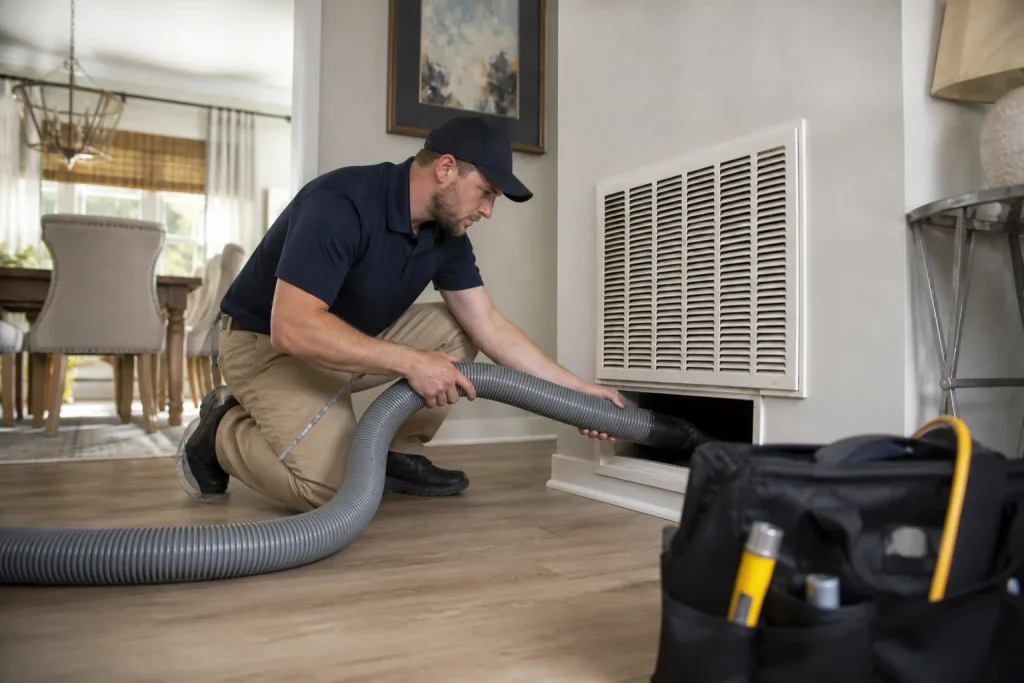
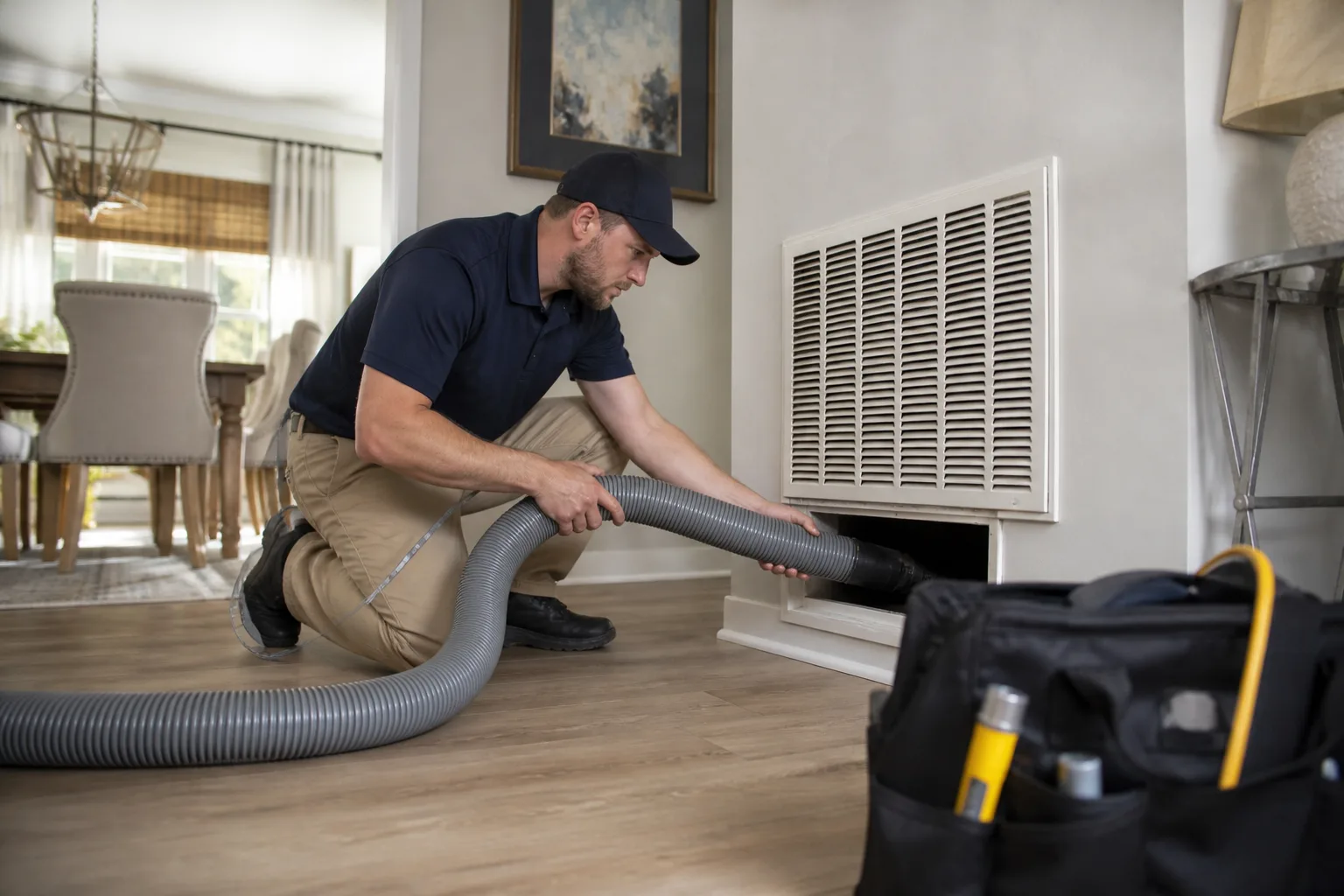
Reverse steps one and three and you’ve spent money on a cleaning that gets undone by the first humid week. We’ve seen that pattern enough times to know it’s the most common costly mistake after a flood in Metairie. The equipment matters too: professional-grade air duct cleaning with a Rotobrush rotary brush and Nikro negative-air extraction removes what’s adhered to the duct walls, not just what’s loose on the floor of the run.
How Do You Shut Down the HVAC System After a Contamination Event?
Turn the system off at the thermostat first, then at the air handler’s service switch, and leave it off until someone has assessed the ducts. That’s the short answer. The longer version matters because a running blower is a distribution machine: if mold spores, soot, or flood silt are sitting in the return plenum or on the evaporator coil, every cycle spreads them through every room in the house.
What to do in order:
- Set the thermostat to Off, not to Fan. Fan mode runs the blower even when there’s no call for cooling, which is exactly what you don’t want.
- Find the service disconnect at the air handler, usually a switch or breaker near the unit, and shut it off.
- Don’t run the system “just to see if it still works.” Let a technician confirm the cabinet, coil, and drain pan are dry and clean before it goes back into service.
- Close supply registers in rooms you’re actively drying if your mitigation contractor asks you to, and keep the return grille covered during demolition so debris doesn’t get pulled in.
If the contamination came from a fire rather than water, the same logic applies: soot is acidic and settles into duct lining, and running the system pushes it into soft furnishings and open surfaces. Shut it down, document it, then call. A Metairie homeowner dealing with smoke residue has a different cleaning scope than one dealing with flood silt, and the inspection should reflect that difference.
What Does a Legitimate Emergency Duct Inspection Look Like?
A real inspection starts with questions and a camera, not a vacuum. A technician who arrives, walks straight to the return and starts pulling hose without asking what happened, when it happened, and what’s been dried is skipping the part that determines whether cleaning is even appropriate yet. That’s the difference between a service call and a sales call.
What a proper inspection in Metairie should include:
- Source and extent questions. What kind of water or contaminant, how deep, how long it sat, and what’s already been dried or removed.
- Moisture readings at the air handler, plenum, and accessible duct sections, written down, not eyeballed.
- Camera inspection of supply and return runs, including the trunk lines you can’t see from a register.
- A written scope describing what will be cleaned, what will be repaired, and what needs to happen before cleaning can proceed.
- Containment planning. Professional remediation-grade filtration, such as Abatement Technologies air filtration units, keeps particulates controlled during the work instead of floating through the house.
If a company shows up fast and starts cleaning without assessing source and extent, that speed isn’t a virtue. Ask for the inspection findings before any equipment gets unloaded. A legitimate provider will happily show you what the camera saw.
How Do You Document Duct Condition for an Insurance Claim?
Photograph everything before anyone touches it, get moisture readings in writing, and ask for a written scope from the contractor before work begins. Insurers process claims on evidence, and ductwork is easy to clean before it’s been documented, which makes the claim much harder. Document first, clean second.
A claim-ready record for a Metairie flood or fire loss usually includes:
- Wide photos of each affected room showing water lines, staining, or soot patterns.
- Close photos of the air handler, drain pan, return plenum, and every accessible register, before cleaning.
- Moisture meter readings with the location and date noted for each one.
- The contractor’s written scope of work, itemized, with the reasoning for each line.
- Before-and-after photos once the work is done, so the adjuster can see what was remediated.
Keep the inspection report even if you don’t file a claim. It’s a record of your system’s condition at a point in time, and that’s useful later. When we work in Metairie, we photograph the ducts we clean so the homeowner has proof of what changed, and the same documentation serves the insurance file.
When Does Duct Cleaning Need a Licensed Mold Remediation Contractor First?
If the duct interior shows visible mold growth beyond a small area, or if mold is growing on structural materials the ducts pass through, a licensed mold remediation contractor needs to handle that scope before any duct cleaning happens. Cleaning ducts that sit inside a mold-affected cavity is putting a clean straw through a contaminated wall. The cleaning won’t hold, and in some cases agitating the system spreads spores further.
Signs you need remediation first, not cleaning:
- Visible growth on drywall, framing, or insulation in the mechanical closet or ceiling cavity around the ducts.
- A musty odor that returns within days of cleaning, which usually points to an unresolved moisture source.
- Moisture readings that stay elevated in building materials after drying was supposedly complete.
- Flood water that sat long enough to wick up wall cavities, which is a structural drying and remediation question, not a duct question.
Once remediation is complete and the structure is verified dry, duct cleaning and any needed duct cleaning Metairie repair work can proceed on a sound footing. That sequencing also protects you: a remediation contractor’s verification gives the duct cleaner a clean baseline to work from. If they can’t fix it, we can. If remediation comes first, we’ll tell you so.
What Else Belongs on Your Post-Flood Checklist in Metairie?
Ductwork gets the attention because it’s visible at every register, but two other items on the same system deserve a look after water intrusion. The first is the condensate drain line and pan, which can hold standing water and become a growth site on its own. The second is the dryer vent, which is often routed through the same flooded wall cavity and can be packed with lint that stays damp long after the structure dries.
A short checklist for a Metairie home after a flood or fire:
- Confirm the air handler cabinet, coil, and drain pan are dry and clean before restarting the system.
- Have the duct system camera-inspected and cleaned once the structure is dry.
- Get the dryer vent cleaning done as part of the same visit if the vent runs through affected space. Damp lint is a fire risk, and it slows drying on every load.
- Check for disconnected or crushed flex runs, especially in attic and crawl spaces where a mitigation crew may have moved things around.
- If ductwork was damaged or disconnected during the event, plan for repair, not just cleaning. Cleaning a leaking system leaves you with a clean system that still leaks.
We keep the scope to three services for a reason: air duct cleaning, dryer vent cleaning, and air duct repair. One call covers cleaning, venting, and repair rather than three separate contractors who each want to be first in line. Our technicians have up to 9 years of experience, and we work with systems using Aprilaire, Honeywell, and Guardsman components, so we’re not guessing at how your equipment was installed.
Related services in Metairie
If you’re sorting out what your system needs after a loss, start with Metairie service details, then decide between cleaning and repair based on what the inspection shows.
When to Call a Pro
Call a professional as soon as water, smoke, or visible growth has touched the duct system or the equipment attached to it. This is not a shop-vac job: consumer vacuums stir up more than they capture, and they can’t reach past the first bend in a flex run. Rotobrush rotary agitation and Nikro negative-air extraction are purpose-built for this, and containment-grade filtration keeps the debris out of the room you’re standing in while the work happens. If the structure is dry and you just want the ducts cleaned, that’s a straightforward scheduled job. If the structure is still wet, call us for the inspection and we’ll tell you honestly whether cleaning can start now or whether drying needs to finish first. We answer 24/7. Fast dispatch from 7am to 7pm, Sunday through Friday, and closed Saturday.
The Bottom Line
After a flood, fire, or mold discovery in Metairie, the order is moisture control first, inspection second, cleaning third. Shut the HVAC system down at the thermostat and the air handler service switch, document everything with photos and moisture readings before anyone touches a duct, and get a written scope before work starts. Skip those steps and cleaning becomes money spent on a problem that comes right back. We clean it, and if it’s broken, we fix it. If you’re in Metairie and need help, Duct Cleaning Metairie offers free estimates. Call (833) 576-1083.
Frequently Asked Questions
Usually no, not until the structure is dry. Ducts cleaned while saturated insulation and framing are still wet get recontaminated within days. Dry the building, inspect the ducts, then clean. Call (833) 576-1083 for an inspection before you schedule cleaning, and we’ll tell you which stage you’re in.
There’s no honest flat number, because post-flood work depends on how much of the system was affected, whether repair is needed, and whether remediation comes first. You get one price per system, in writing, agreed before work starts, with no per-vent pricing. Call (833) 576-1083 for a free estimate.
Don’t. Run the blower with contaminated ducts and you spread spores, soot, or silt through every room. Use dehumidifiers and air movers instead, and leave the system off until a technician confirms the cabinet, coil, and drain pan are clean and dry. Then call (833) 576-1083 to book the inspection.
Ask for before-and-after photos of your own ducts, not stock images, plus the written scope describing what was cleaned. A legitimate provider documents the work because the documentation protects both of you. Call (833) 576-1083, and we’ll walk you through what the photos should show.
Written by the team at Duct Cleaning Metairie.
Need Air Duct Cleaning Help?
Call Duct Cleaning Metairie - licensed & insured, with free written estimates in Metairie.
(833) 576-1083