
Nikro Air Duct Cleaning in Metairie: A Homeowner’s Guide
A shop vac pulls maybe 1 to 2 inches of water column in negative pressure. A Nikro commercial HEPA vacuum unit pulls well over 100. That difference is everything. One stirs dust around inside your ducts; the other actually lifts it out of a 20-foot flex run and traps it. Most homeowners can’t tell which machine is in their hallway, and that’s exactly how weak duct cleaning gets sold in Metairie. Here’s how to know what you’re paying for.
What does Nikro equipment actually do that a shop vac can’t?
Nikro builds commercial HEPA vacuum units and negative-air machines for restoration and duct work. The core idea is source removal: dislodge the debris where it sits, then pull it into a sealed container instead of letting it drift through the house. A consumer vacuum creates enough suction to agitate a surface. A Nikro unit creates enough negative pressure to keep an entire duct run under suction while a rotary brush travels through it.
Three specs matter when you’re evaluating a quote:
- Water column lift. Consumer shop vacs sit in the 1 to 2 inch range. Commercial HEPA units in the Nikro class operate far higher, which is what lets them hold vacuum through long, restrictive runs.
- CFM (cubic feet per minute). Lift alone doesn’t move debris; you need air volume. High CFM plus high lift is what turns a duct system into a single extraction path.
- HEPA filtration stages. Multiple filter stages trap what the vacuum pulls so the exhaust air is cleaner than the room air. A machine without real HEPA stages just relocates dust into your hallway.
This is why the equipment on the truck matters more than the price on the flyer. If you’d rather skip the DIY research entirely, call (833) 576-1083.
How does a Nikro-vacuum job actually run in a Metairie home?
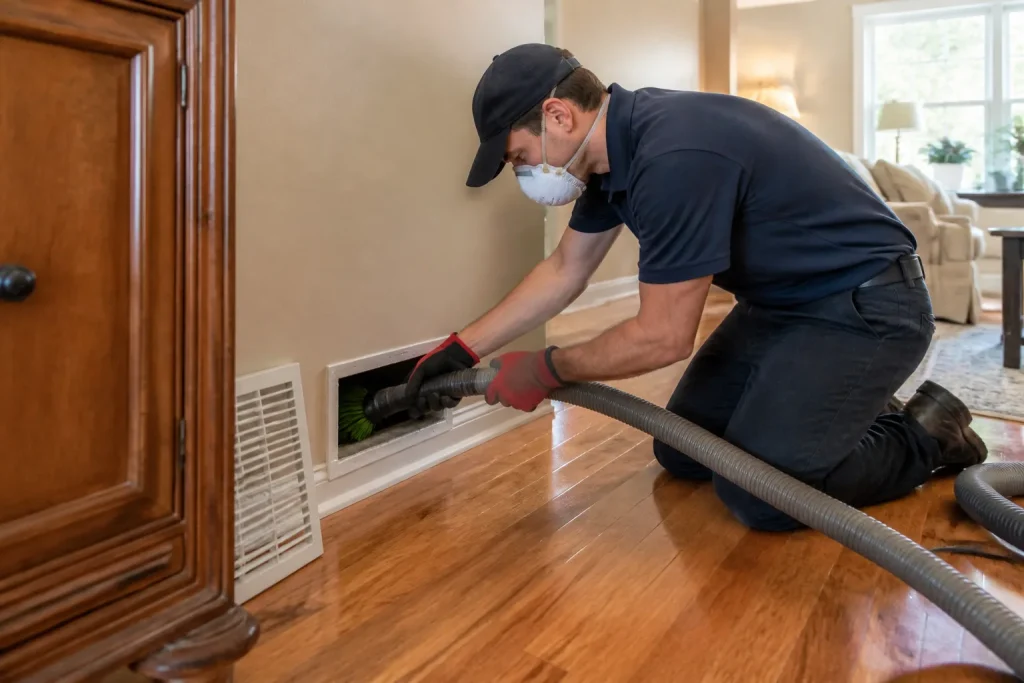
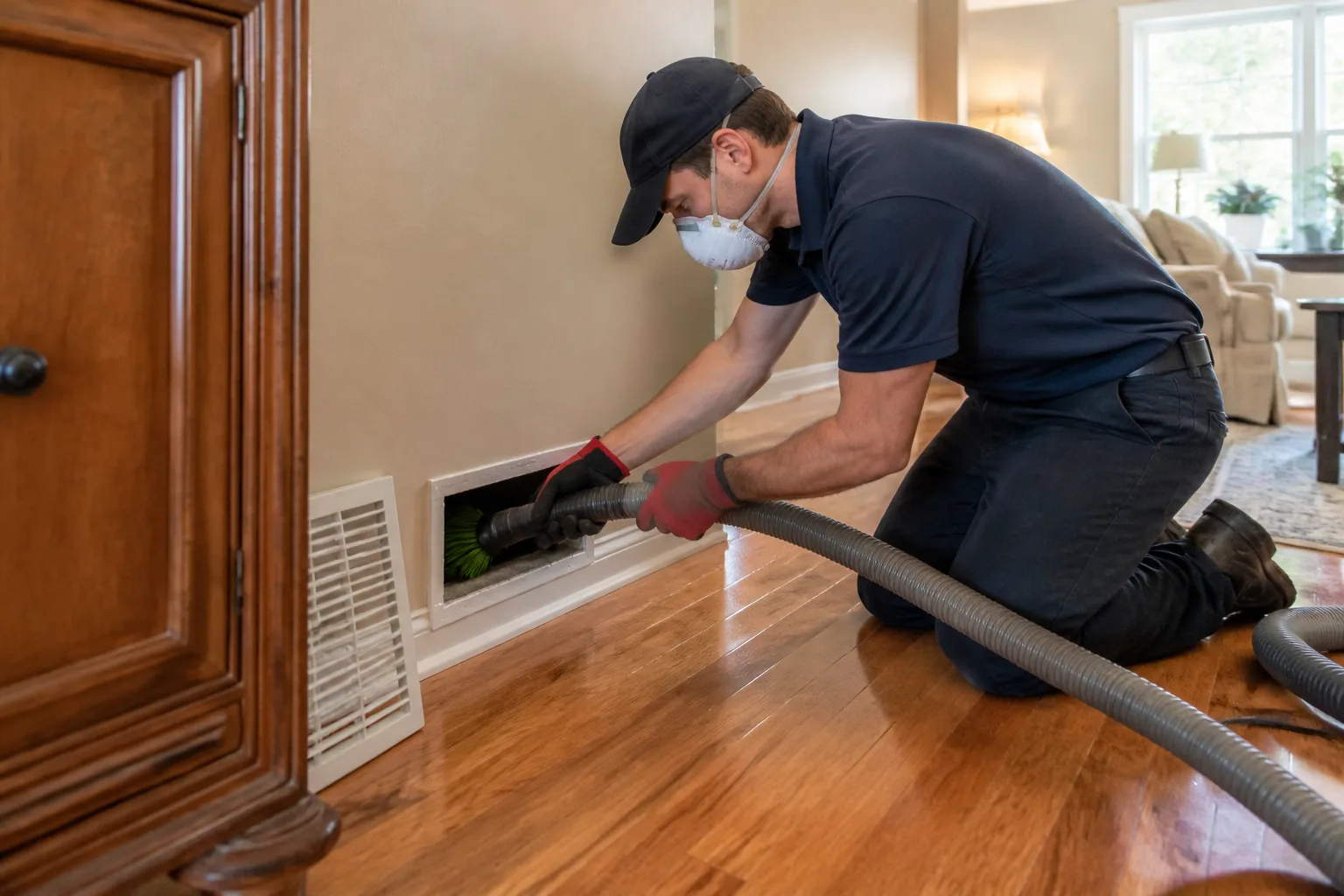
A properly equipped job follows a sequence, and you should be able to watch it happen. First, the technician places access ports at strategic points in the duct system, not just at the registers. Second, the vacuum hose is routed to the exterior or to a sealed collection point so extracted material leaves the house. Third, the brush works each run from the register back toward the air handler, not the other way around.
That direction matters. If a technician brushes from the air handler outward, debris gets pushed back into the system and the extraction never catches up. Working register-to-handler forces the loosened material into the vacuum’s pull. On a Nikro job you’ll also see Abatement Technologies filtration units on site to contain particulates while the work is happening. That’s a signal the contractor treats a duct cleaning as a controlled environment, not a quick vacuum.
While the work is running, watch for these:
- Are access ports being cut and later sealed, or is everything happening only at the grilles?
- Is the vacuum hose actually running outside, or is it looped back into the room?
- Is the technician moving the brush methodically, run by run, or waving it around?
- Are they documenting before-and-after condition of the duct interiors?
None of that requires a technical background. It just requires knowing what to look for. In our experience, homeowners who ask these questions get better work.
Why duct material changes the technique in Metairie homes
Not every duct is built the same, and the equipment has to be adjusted to match. In the Metairie housing stock, three duct materials show up most often:
- Flex duct. Corrugated, spring-reinforced, and easy to over-brush. Too aggressive a rotary brush can tear the liner or disconnect joints. The correct approach uses lower brush pressure and slower travel speed.
- Fiberboard (duct board). A compressed fiberglass panel system common in this region. Brush contact has to be light and consistent; the wrong setting scuffs or shreds the interior surface, which then becomes a permanent trap for dust.
- Sheet metal. The most forgiving, but joints and seams still need proper agitation. Sheet metal runs often hide debris pockets at elbows and transitions that a brush-only approach can miss.
The reason professional equipment matters here is that Nikro rotary brush systems are adjustable, and a properly trained technician changes brush stiffness and rotation speed by duct material. Reporting that a full cleaning was done with a single brush setting across mixed ductwork is a red flag.
Why HEPA containment is critical in older Metairie homes
Older Metairie homes have layered histories. A house may have been renovated two or three times, and ductwork frequently gets spliced, rerouted, or partially replaced along the way. All of that disturbance leaves debris behind that a simple vacuum pickup can’t neutralize.
That’s why HEPA containment during the job is not marketing language. A unit without proper filtration exhausts fine particulate back into the room, and that fine particulate is exactly what you don’t want to breathe. Abatement Technologies filtration and negative-air equipment used on-site is one way to identify a contractor who takes this seriously. And when the ducts turn out to have a leaking joint or a disconnected run, the fix isn’t more cleaning. It’s repair. We clean it, and if it’s broken, we fix it.
The other piece of this is the air handler itself. Ask any contractor how they protect the air handler while working, and whether they’re using a HEPA machine or just a standard vac. A contractor who can’t answer that clearly probably isn’t running HEPA-grade gear. For homeowners in Metairie who are weighing bids, that one question sorts serious quotes from the rest.
How do you verify a contractor is really using professional equipment?
Ask direct questions before the appointment. And ask again when the technician arrives, because the equipment should be visible and should match what the office told you.
- “What unit are you bringing?” A real answer names a brand and a model family. “A really powerful one” is not an answer.
- “Do you use Abatement Technologies or an equivalent for containment?” If the answer is no, ask what they use instead and whether it’s HEPA-rated.
- “Show me the unit when you arrive.” Consumer shop vacs with a commercial sticker are a thing. The machine should have visible filter stages and a rated label.
- “How many access ports will you cut, and will you seal them?” Proper cleaning requires a real entry point, and the port should be sealed after the job.
- “Which parts of the system do you actually clean?” You want to hear registers, supply runs, trunk line, and the return side, not just one section.
Whether a contractor uses Nikro, Rotobrush, or another professional-grade system is less important than whether the machine is genuinely industrial. In our experience, the moment you ask about the machine by name, the wrong contractors start talking about schedule instead.
When should you actually call a pro instead of waiting?
Duct cleaning can wait when the system is working well. It can’t wait when the symptoms start stacking up. Call a pro if you’re seeing more than two of these at once:
- Visible dust puffing out of the supply registers when the system kicks on.
- Noticeable allergy or respiratory irritation that worsens indoors.
- A persistent musty or dusty odor from the vents.
- Recent remodeling, roof work, or pest activity in the house.
- A dryer that now needs two cycles to dry a normal load.
That last point is worth separating out. Dryer vent cleaning is its own service, and a clogged vent is a genuine fire risk, not a maintenance nicety. If your dryer is slow, get the vent cleaned and stop waiting. For ductwork issues, see our full air duct cleaning overview, and if the problem is the dryer, start with dryer vent cleaning.
Related services in Metairie: dryer vent cleaning and air duct repair for damaged or disconnected runs.
The Bottom Line
Nikro air duct cleaning is not about brand loyalty. It’s about whether the machine has the lift, airflow, and filtration to actually remove debris from a duct run instead of stirring it up. In a Metairie home, that means the right equipment for the duct material, proper access port placement, HEPA containment while the work happens, and repair capability if the system turns out to be broken.
Our technicians have up to 9 years of experience with Nikro and Rotobrush systems, and we treat Metairie ductwork with the same care we’d want in our own homes. If you’re not sure whether your system needs cleaning or repair, ask. We answer 24/7. Fast dispatch from 7am to 7pm, Sunday through Friday. If you’re in Metairie and need help, we offer free estimates – call (833) 576-1083. Estimates are free.
Frequently Asked Questions
Neither is universally better; they serve different parts of the job. Nikro is best known for its high-lift HEPA vacuum units, while Rotobrush is best known for its rotary brush agitation systems. A properly equipped contractor often uses both: agitation to loosen debris, high-lift extraction to remove it. Ask what each company brings to your job rather than which brand they prefer. Call (833) 576-1083 for a walkthrough of what we bring.
Pricing depends on the size of the system, the number of runs, and whether any repair work is needed. Rather than quote per register or per vent, we give one flat price per system agreed before work starts. That protects you from the bait-and-switch that’s common in this trade. Call (833) 576-1083 and we’ll walk your system and give you an exact number, free.
Ask to see the unit when they arrive. A real commercial HEPA machine has visible filter stages and a rated label; a consumer shop vac with a commercial sticker does not. Ask about access port placement and whether extraction goes outside. If the answers are vague, that’s your answer. Call (833) 576-1083 if you’d like to know what we bring before you book.
Cleaning can eliminate a large share of the musty smell by removing the dust, debris, and organic matter that feeds it. If the smell persists after cleaning, there may be moisture getting into the system, and that means a ductwork inspection and possible repair, not another cleaning. Call (833) 576-1083 and we’ll tell you what we find.
For the broader picture on our work and what equipment-level duct cleaning looks like across the area, start at Duct Cleaning Metairie. One call covers cleaning, venting, and repair. Call (833) 576-1083. We answer 24/7. Fast dispatch from 7am to 7pm, Sunday through Friday. We’re closed on Saturday.
Written by the team at Duct Cleaning Metairie.
Need Air Duct Cleaning Help?
Call Duct Cleaning Metairie - licensed & insured, with free written estimates in Metairie.
(833) 576-1083